STEM toys worth buying, from first building sets to science kits
Good STEM toys let children try something, see what happens and try again, whether that’s a marble run, an experiment or a logic puzzle. For three- to five-year-olds that means building, sorting and counting; from about eight it can mean fizzing chemistry with a Horrible Science kit or physics with GraviTrax.
STEM stands for science, technology, engineering and maths, and the label gets stuck on almost anything. We’ve ignored the sticker and looked for toys where the learning is built into the play: puzzles with graded challenges, building sets with no single right answer, and kits that actually do something.
Our picks run from a Rubik’s Cube under £10 to bigger sets under £100, for ages 3 to 14. A few need batteries, and we’ve said so.
The picks
 Ages 8+Steal
STEM and science
1. Ravensburger GraviTrax Starter Set
4.8(2.2k)
A modular marble run where children design tracks at different heights and see gravity and momentum at work. Expansion packs let it grow with a child from 8 up.
- Endless layouts, so no two runs need be the same
- Expansion packs let it grow over birthdays and Christmases
- Explores physics ideas through play
~£35See it → Ages 3–7Steal
STEM and science
2. Gears! Gears! Gears! Beginner’s Building Set
4.6(4.3k)
Click gears and cranks onto base plates and watch one gear turn the next. Open-ended early engineering for 3 to 7, with no right or wrong answer.
- See cause and effect as one gear turns the next
- Open-ended building with no right or wrong answer
- Expands with other Gears! Gears! Gears! sets
~£27See it → Ages 8+Steal
STEM and science
3. ThinkFun Gravity Maze
4.6(2.7k)
Plan a marble’s path through a tower before you let it go, with challenge cards from easy to expert. A solo logic puzzle for tinkerers aged 8 and up.
- Combines logic puzzles with building
- Challenges move from easy to expert
- Solo play suits independent tinkerers
~£16See it → Ages 3–7
STEM and science
4. Learning Resources Design & Drill Bolt-It Bucket
4.5(3.3k)
A toy drill, coloured bolts and a pattern guide, with a lid that doubles as the bolt board. Early engineering and fine motor practice for 3 to 7.
- The lid doubles as the bolt board, so it all packs away
- Pattern guide builds colour and shape matching
- Portable for trips to grandparents’ houses
~£30See it → Ages 8–12Steal
STEM and science
5. Galt Horrible Science Explosive Experiments
4.5(5.1k)
Eight experiments that fizz, pop and bubble, with Horrible Science humour to keep it fun. Chemistry for 8 to 12 at the kitchen table, with a grown-up alongside.
- Eight hands-on experiments in one box
- Horrible Science humour keeps it fun rather than lesson-like
- Great for curious Key Stage 2 kids who ask ‘why?’ a lot
~£15See it → Ages 3–7Steal
STEM and science
6. Numberblocks MathLink Cubes 1-10 Activity Set
4.7(7.9k)
Snap MathLink Cubes together to build Numberblocks One to Ten from the CBeebies show. A hands-on way to see how numbers are made, for 3 to 7.
- Familiar CBeebies characters make counting feel like play
- Linking cubes shows how bigger numbers are built from smaller ones
- Handy for Reception and Year 1 maths at home
~£20See it → Ages 6+Steal
Puzzles and brain teasers
7. The Genius Square
4.8(7.8k)
Roll the dice to place the blockers, then race to fit your shapes into the grid. A new logic puzzle every roll, solo or head-to-head, for 6 and up.
- A new puzzle every roll, so it never runs out
- Play head-to-head, or solo against the clock
- Quick rounds that fit into a few spare minutes
~£14See it → Ages 4–10
STEM and science
8. Hape Quadrilla Cliffhanger Marble Run
4.5(589)
A wooden marble run for building twisting routes and watching cause and effect in action. Works with other Quadrilla sets, for patient engineers aged 4 to 10.
- Wooden pieces that build into different marble routes
- Shows cause and effect as marbles race down
- Works with other Quadrilla sets to grow the run
~£65See it → Ages 6–10Steal
STEM and science
9. Galt Kitchen Lab Science Kit
4.5(696)
Six beginner experiments that turn the kitchen table into a lab for an afternoon. A first taste of real science for 6 to 10, usually under £10.
- Six experiments give a first taste of real science
- A rainy-day project for kids who ask ‘why?’ a lot
- Great for doing together with a grown-up or older sibling
~£7.49See it → Ages 4+Steal
Building and LEGO
10. LEGO Classic Medium Creative Brick Box 10696
4.8(35k)
A box of mixed LEGO Classic bricks with no single model to follow, so children design and test their own. Suits 4 and up, usually under £25.
- Open-ended bricks for building anything, not just one model
- Eyes bring creatures and characters to life
- The storage box makes tidying up less of a battle
~£20See it → Ages 3–8Steal
STEM and science
11. GraviTrax Junior Starter Set XXL Planet
4.8(478)
The junior GraviTrax, made for children from 3, in a big space-themed starter set. A gentle first marble run for 3 to 8; supervise little ones with the marbles.
- Made for younger builders than the main GraviTrax range
- Space theme adds stories to every marble run
- A big starter set with plenty of layouts to try
~£74See it → Ages 3–8Fan fave
Building and LEGO
12. PicassoTiles 100-Piece Magnetic Tiles
4.8(35k)
A 100-piece set of clear magnetic tiles for testing what balances and what falls down. Open-ended shape and building play for 3 to 8, usually under £50.
- 100 pieces is enough for tall towers and big castles
- See-through tiles look lovely in sunlight
- Open-ended play, from toddler stacks to complex shapes
~£34See it → Ages 8+Steal
Puzzles and brain teasers
13. Rubik’s Cube 3x3
4.7(15k)
The original 3x3 cube, a puzzle about patterns and step-by-step methods that can last for years. Usually under £10, for 8 to adult.
- A classic that parents can have a go at and help teach
- Plenty of free beginner guides online for learning step by step
- Pocket-sized, screen-free challenge for car journeys
~£7.50See it →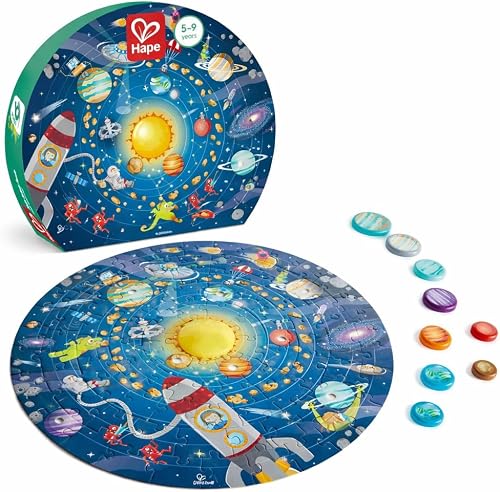 Ages 3–8
Puzzles and brain teasers
14. Hape Solar System Puzzle with Glowing Sun
4.7(915)
A round wooden jigsaw of the planets in order, with a sun in the middle that lights up.
- Solid wooden pieces that stand up to lots of puzzling
- The glowing sun makes it a favourite at bedtime
- Helps little ones learn the planets in order
~£27See it →
Buying advice
What STEM looks like at each age
Under 5: counting, sorting, matching colours and building. Design & Drill, Gears! Gears! Gears!, Numberblocks MathLink Cubes and magnetic tiles all fit. This is maths and engineering at its simplest: which shapes fit, which gear turns which, what balances and what falls down.
Ages 5 to 7: quick logic puzzles, like The Genius Square, first science kits, like the Galt Kitchen Lab, and building with bricks, like LEGO Classic, where children start planning a model before they build it.
Ages 8 and up: real cause and effect. GraviTrax and Gravity Maze are physics and planning; the Horrible Science kit is chemistry that fizzes, pops and bubbles; the Rubik’s Cube is patterns and step-by-step methods.
Graded challenges are the secret
The science and logic toys that last tend to have challenge cards that start easy and get hard. Gravity Maze works this way, and The Genius Square sets a new puzzle with every roll of the dice. A child can play alone, get stuck, come back later and crack it, which makes them good for a rainy half-term.
Open-ended sets, like LEGO Classic, GraviTrax or Hape’s Quadrilla marble run, last for a different reason: there’s no final level, just bigger and more ambitious builds. If you’re choosing between two toys, ask which one a child could still be playing with in six months.
Batteries, supervision and space
Check what a kit needs before you wrap it. The Design & Drill set and the glowing sun on the Hape solar system puzzle may need batteries, so look at the listing for the type and whether they’re included. Science kits like the Galt Kitchen Lab and Horrible Science need a grown-up alongside and can call for everyday kitchen items, so read the instructions before the big day. Marble runs come with marbles, which are a choking hazard, so keep them well away from babies and toddlers.
GraviTrax and big LEGO builds need a table or floor space that can stay set up for a while. A large tray or an old board stops a half-finished project being tidied away mid-experiment.
How we picked
We shortlist science and building toys with strong Amazon reviews, check they’re sold on Amazon UK and suit the age on the box, and favour toys with graded challenges or open-ended building so they last beyond the first week. A box saying STEM isn’t enough on its own.
Questions people ask
What does STEM stand for?
STEM stands for science, technology, engineering and maths. In toys, it usually means play that involves building, testing, measuring, logic or cause and effect. Some schools and toy makers say STEAM, adding art. Anyone can put the label on a box, so it’s worth looking at what a toy actually asks a child to do rather than trusting the packaging.
What is a good STEM toy for a 3 year old?
At three, STEM play is hands-on: building, stacking, sorting colours and fitting things together. Magnetic tiles, Design & Drill, Gears! Gears! Gears! and the GraviTrax Junior starter set all fit. Check the age mark, as many science kits have small parts unsuitable for under-threes, and steer clear of anything that needs reading or careful measuring at this age.
Are STEM toys worth it for a 10 year old?
Yes, if you choose something with depth. At ten, children can handle GraviTrax, Gravity Maze and The Genius Square, all of which have challenges that get harder or builds that get bigger over time. A Rubik’s Cube suits a patient child who’s happy to learn a method step by step. Avoid one-off kits that are finished in an afternoon, unless that’s all you want.
Do science and building toys need batteries?
Most don’t. Puzzles, marble runs, building sets and logic games work without power. The Design & Drill set and the light-up sun on the Hape solar system puzzle are the ones to check here, so look at the listing for the battery type and whether batteries are included.
What’s a good STEM gift for a child who loves LEGO?
Look for something that adds a challenge to building. A LEGO Classic box invites free design rather than following one model, and a Creator 3 in 1 set, like the Space Shuttle, shows how the same bricks make three different models. GraviTrax appeals to the same children, because they design the track, test it and fix what doesn’t work. All three suit children who like to tinker.